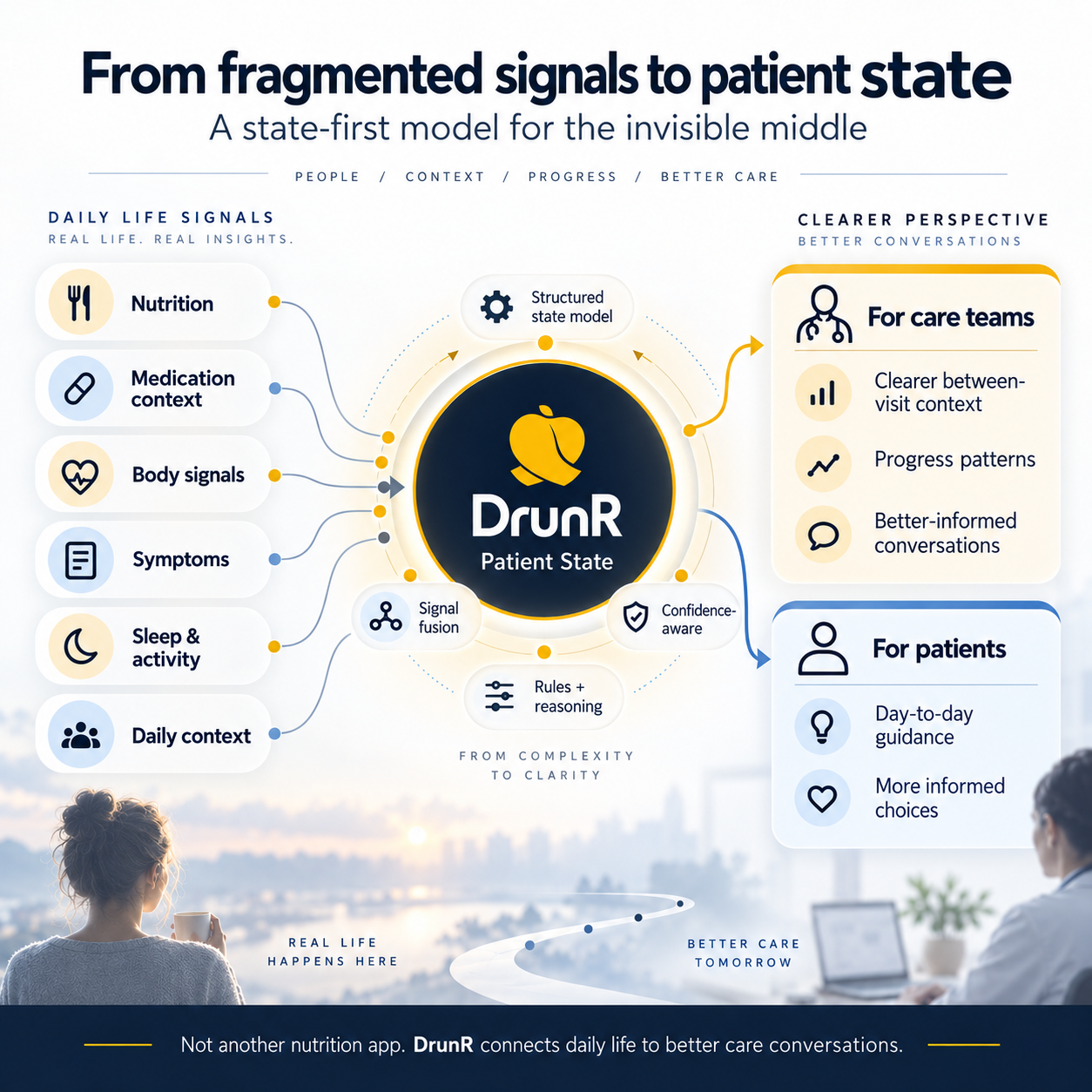
Healthcare often happens in snapshots. A patient comes in, goals are discussed, medication is prescribed or adjusted, and then they return to everyday life. By the time the next visit arrives, weeks may have passed and a lot can change in between: appetite, sleep, activity, symptoms, nutrition, stress, medication experience and routine.
Care teams eventually see the outcome, but they may not see the sequence of everyday changes that helped produce it. At DrunR, we call that gap the invisible middle - the thousands of hours when patients are living with care plans outside the clinic. Our focus is increasingly on making that period more understandable to both the patient and the people caring for them.
From fragmented signals to patient state
Patients already generate a lot of information. Wearables may capture sleep, activity and body signals. Nutrition tools capture another part of the picture. Medication context, symptoms, recent behavior and personal goals may live somewhere else entirely. The problem is not simply that healthcare lacks data; it is that these signals are often separated from one another and therefore difficult to interpret as a coherent picture of the person.
This is why we no longer think of DrunR as a nutrition app. Nutrition is important, but it is one input into a broader model.
We are building around patient state: a structured representation of what may be happening with a person now, based on the information actually available. Rather than sending a pile of raw information directly to a language model and asking it to decide what the patient needs, our approach is to organize the signals first, apply defined rules and safety boundaries, and only then use AI to help communicate the result.
That distinction matters. A language model may be very good at producing an explanation, but the explanation should come from a structured understanding of the patient rather than from the model inventing its own interpretation.
There is a model underneath the conversation
The patient-state layer we are developing is not simply an AI-generated summary. Our current GLP-1 prototype uses defined state dimensions and combines multiple forms of evidence rather than treating one measurement as the whole story. Those dimensions currently include areas such as GI sensitivity, protein priority, recovery need, hydration priority and glycemic watch, with more than one dimension able to be active at the same time. Importantly, the model also treats missing information as unknown, rather than silently interpreting missing data as normal.
We are also designing the model to carry its own context about how a conclusion was produced. Provider-facing traces can include the active state dimensions, what information was used, what was missing, confidence, algorithm versions and the factors that influenced an output.
That means the goal is not just personalization. It is traceability.
This work is still a prototype and requires continued validation. We are not positioning patient state as a diagnosis or a replacement for clinical judgment. In fact, part of the design is knowing when the system does not have enough information and should avoid making an unsupported conclusion.
Supporting the care team, not creating another dashboard
The last thing most clinicians need is another screen full of raw numbers.
What may be more useful is a clearer answer to questions such as: What has meaningfully changed since the last visit? Which patterns appear consistent? Where is the information incomplete? What has the patient been struggling with? What might be worth discussing now?
For the patient, the same underlying state can support a different question: What makes sense for me today?
For the care team, the question becomes: What has been happening with this person between visits, and what deserves attention?
That is where we see DrunR going. Not as another food tracker and not as another wearable dashboard, but as a care-support layer for the invisible middle - bringing fragmented daily signals into a structured patient state that can support everyday decisions and make the next care conversation more informed.
The question we want to keep asking care teams is simple:
What would actually help you understand what happened between visits without giving you more noise?
That answer should shape what we build next.